


Could YOUR SUPPORT become part of our sustainability ecosystem?
Please consider becoming:
a paid member to support our cause; get 1 free ticket to one of our events;
a Worlding Super Supporter: get access to all our events free of charge (does not apply to art suppers & events by external entities).
A simple click on the button below and it’s done.
Interested in becoming a Patron? ⇢ worldingproject@gmail.com
INTERVIEW WITH SAMEER FAROOQ
Artist in Residency - April 2026
By Joana P. R. Neves

Canada <-> International has established an annual Toronto-focused residency with Worlding, London (UK). In partnership with the Toronto Biennial of Art (TBA), residency artists will be selected from TBA’s past and present editions, deepening their engagement both locally and internationally.
Save the Date: Open Studio on Tuesday, 28 April.
📍 WORLDING, Elephant & Castle, SE1 4AD
Empathy for the Institution
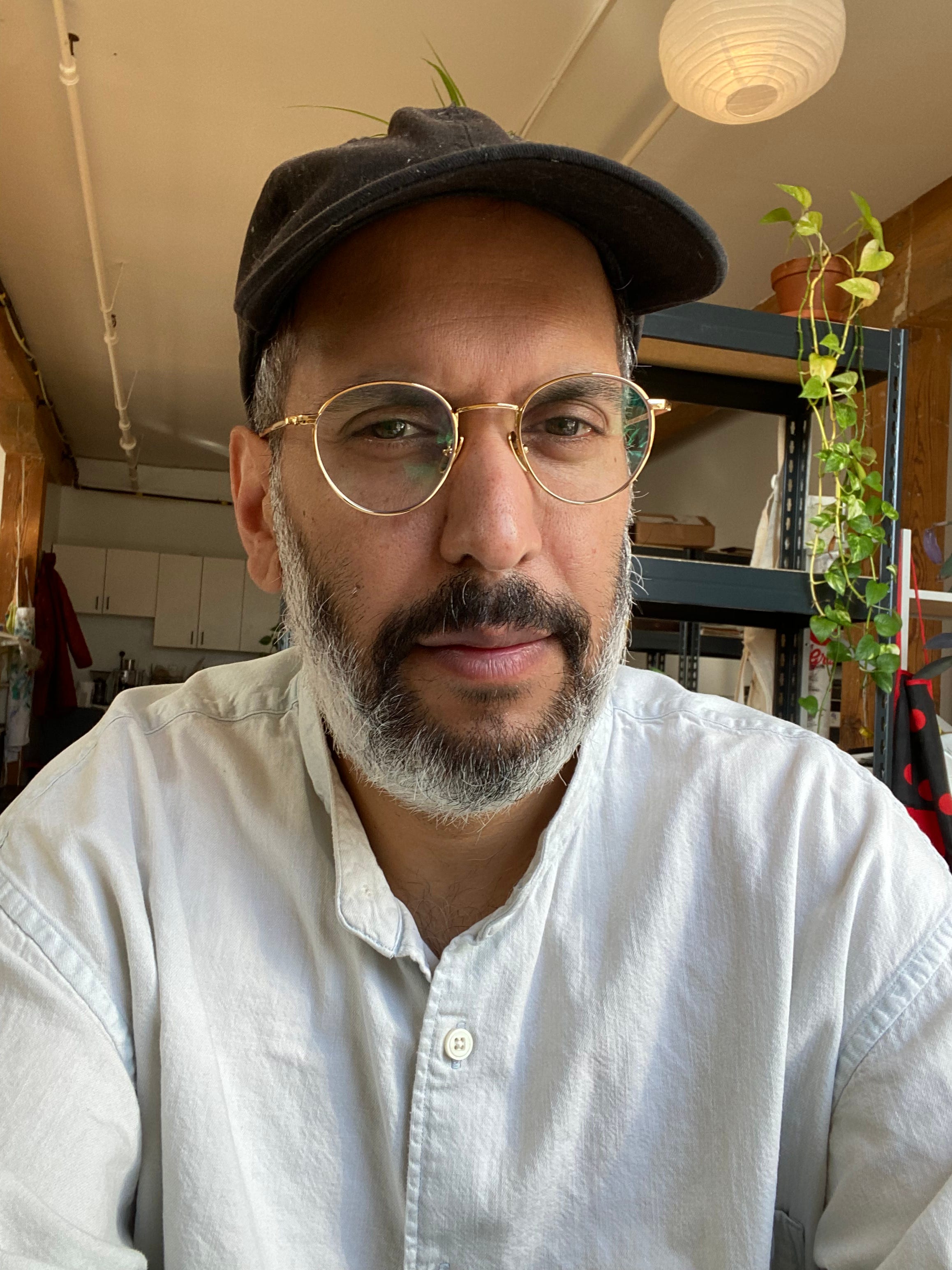
Personifying the museum might be one of the strangest forms of “institutional critique” I’ve come across recently. Worlding’s April resident, Sameer Farooq, has imagined what would happen if the museum saw a therapist, in collaboration with the Dutch artist Marjam Linschooten. Their video The Museum Visits a Therapist, 2021, is the outcome of a four-year engagement with Amsterdam’s Tropenmuseum, and will be on display during the artist’s Open Studio on the 28th of April 2026. Save the date!
It’s fair to wonder whether Sameer Farooq’s approach to the art institution is as acerbic as Hans Haacke’s, or, later, Andrea Fraser’s. As a second generation immigrant in Canada – his mother is of Ugandan descent, and his father was born in Pakistan – he would be well placed to do so, but the word “empathy” does come up during our conversation regarding the inheritance of the massive, and problematic collections amassed over years of colonial rule. Perhaps because before embracing an artistic career, Farooq studied cultural anthropology at McGill University in Montreal, his focus on archival systems – now as an artist – is equipped with an awareness of the complex scientific and subjective stories behind archives.
Can an Object Hide its History?
Fascinated by objects, by what they carry and how they might catalyse life, Farooq seems closer to the constellation of artists for whom the museum is a source of concerned fascination: inherently imperial, governed by the current versions of old empires, managed by wealth, it is also visited and curated by people who genuinely care about what is there. The question might then be: aren’t we missing out on a clear-eyed view of the museum as a tool for dialogue about the difficult histories it encloses? The artefacts exhibited represent cultures and have specific roles in them. But the reason why they were taken, and the local cultural entanglements they represent are often obliterated by a grandiloquent language focusing on possession, luxury and exception, taking over global discourse, and uncritically touching upon notions of nationality and identity.
Do artists have a role to play there? Sameer Farooq took the matter into his own hands by looking at what sustains the object rather than the object itself: the bureaucratic limbo, the compulsive scenography, the unquestioned typologies, through productions whose artistic language is chosen for each situation, such as ceramics, photography, video, museum displays, and more. But first, I wanted to find out more about his life growing up in Canada and the root of his affinity with object displays.
Follow Sameer Farooq on Instagram
The Chest in the Basement
Joana P. R. Neves: I’m curious about your life growing up in Cape Breton, and your relation to objects. Were you always fascinated by them?
Sameer Farooq: Some of my earliest memories are of, as a young child, sitting on the floor and rifling through objects, ordering them, trying to understand where each one came from, and their meaning. In our basement, we had a chest with what my parents could take when they left Pakistan and Uganda. My father is from a small village in Punjab, Pakistan, and my mom is from Uganda, in East Africa. They met in the UK. My mom and her family were expelled during Idi Amin’s rule in the early 70s; my father was a medical resident in the UK. In the 60s, there wasn’t a lot of upward career movement because of racism: he describes having colleagues at the same level being promoted for jobs in the hospital, while the South Asian ones remained in lower positions. So, on a romantic walk, my parents passed by the Canadian embassy and said: “let’s go in and see if we can move to Canada”. Canada being desperate for professionals, the woman signed the paper immediately They were welcoming professionals in rural, outlying areas, so my parents ended up in Eastern Canada on the small Cape Breton Island, off the coast of Nova Scotia. But they fell in love with it and its community. I think it reminded them of the UK, as a very Scottish and Irish area. My brother and I were born and brought up there.
Back to the chest in the dusty basement: I remember going alone and opening it. There was a large snake skin that my mom had kept from Africa, there were etched, tin vases that my dad brought from Pakistan, some photographs… I tried to make sense of the past and of where we were: a floor above, there were mass produced objects from Canada and the United States, plush carpeting, artificial flowers, ceramic animals – it was the 1980s! That’s when the obsession arose.
J.P.R.N.: You said you ordered them? What did you do with those objects?
S.F.: I would lay them out, I would play with them. It’s an interesting question: what makes a museum? Could that be a museum? When we think about the earliest museum, Ennigaldi-Nanna’s…
J.P.R.N.: Yes! The first ever curator that we know of, was indeed a woman, Ennigaldi. Her museum was built around 500 BCE and was located in current Iraq. Objects were found and she thought: ”we have to organize, study and show them to people”. There was a motivation of keeping and showing and ordering and making sense. I guess you had the same instinct as a child!
S.F.: I think about what this psychological pull to spatially organize objects in a room is about. I studied anthropology in university. Then, I worked at the Canadian embassy, in the foreign service, in Beijing. My job was, mainly, helping Canadians in emergency situations: making passports, shipping back bodies of deceased Canadians, trying to uncover business scams by Canadians in China... It was a really weird job. But having that anthropology lens gave me a critical outlook on wherever I lived. I ended up going back to China a number of times as a documentary filmmaker. After, I went to art school in Amsterdam, where this combination of anthropology studies and art came together. Now I feel a proximity to the visual anthropologists, but my work is a little freer, less scientific and more associative, performative, instinctual.
Imperfect Archives
J.P.R.N.: Are there any anthropologists that left a mark–or the opposite?
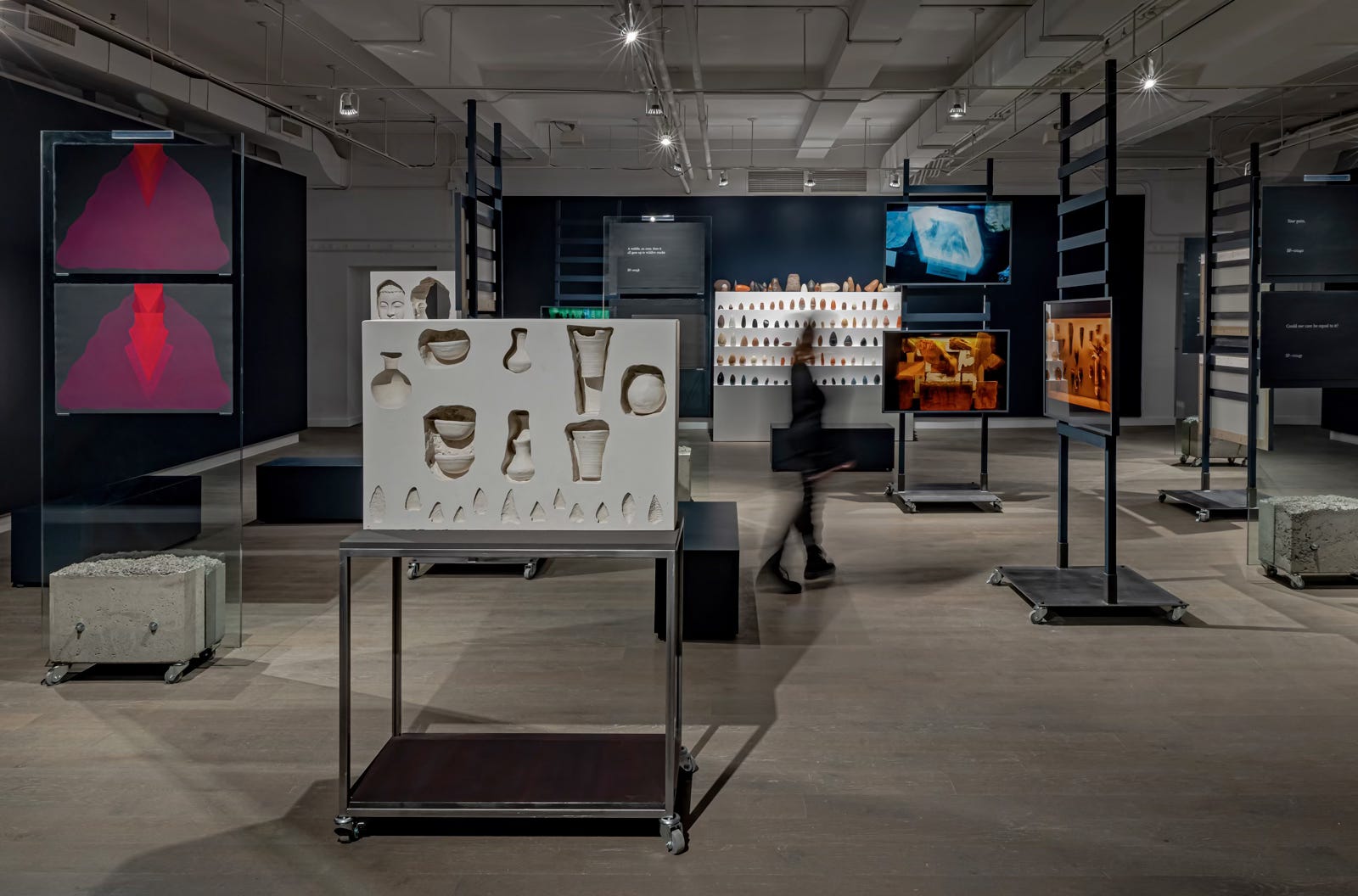
S.F.: Ann Laura Stoler, who is a New York based anthropologist. She wrote a book called “Along the Archival Grain”1; it has affected a lot of my work. It looked into Dutch colonialism, especially in Indonesia. She came across ledgers and records kept during their violent colonial rule. She noticed that, rather than being a brute, organized, relentless force,it was made up of young soldiers who had no idea where they’d landed. So, in the marginalia of the documents there were mistakes, things crossed out, a lot of anxiety in documenting. When I work with institutions, I’m interested in them as places that are invented and falling apart, continually. And by, like Ann Laura Stoler, not assuming that the perpetrators were all powerful, but naive, questionable, inadequate, non-experts. It breathes a lot of empathy in the institutional critique model. She has been a huge influence. And I continue to love anthropology – it has a dubious history, but it is a self-critical discipline. What I loved about studying it, was its willingness to admit mistakes and keep reinventing itself. When I meet contemporary anthropologists, I ask them what they’re reading, what they’re thinking about now, how the models changed.
J.P.R.N.: Picking up on this contradiction that we were flagging up in the beginning, the compulsiveness in organizing objects from the past or other cultures, and then turning them into museums: your work touches upon those structures, and the puzzling effect of cutting us away from the reality of the objects, but also connecting us to yourselves. How do you contemplate this contradiction with empathy?
S.F.: I lost my brother and it set me into a deep investigation into grief. And the museum is a space of grief. Grief for the communities who have lost their objects, but also of the institutions for having to restructure and repatriate what they have known for the last century. So there’s a lot of loss in those spaces. Meanwhile, in order to survive this loss in my life, I had to come up with protocols to rehabilitate myself. There was a Tibetan Buddhist Sangha in my neighborhood; I started going there, getting into meditation. I appreciated how Buddhism has dealt with grief and levels of loss. I also became curious about visualization exercises in meditation. Images, objects and language living inside of the body rather than outside, really started to come to the fore. Over three or four years, I was exposed to somatic body practices, visualization, intuition techniques, which started coming into my art practice. I was also touched by something the curator Massilmiliano Gioni said:“Besieged as we are by the profusion of images that characterize our present, we might be tempted to close our eyes — only to realize that pictures have always been swarming behind our eyelids”. So, I had the idea of the internal archive, as opposed to the external archive. As an artist, I started to think of the external archive as being linked to colonialism: the tools of photography, scanning, etc – this visible world where museum collectors, missionaries, military people would grab all that they could, and bring to the museum. As a counterbalance, we can start focusing on our internal archives. We already hold a vast amount of storage in our mind’s eye, which we can begin to articulate, visualize.
J.P.R.N.: We intersect the structures of power of the museum when we visit them, and we make our own archives. We build our own relationships with them. It might be a mistake to presume that the superstructure, to speak in Marxist terms, affects only directly, unilaterally and uniformly the people who activate the museum. Ben Luke wrote in the Art Newspaper that he wanted to know, in the museum, through more texts, what those objects were, what they were doing there, how they got here, how we treated them when they arrived. For the public, it may be more interesting to know this colonial story, to be empowered by knowledge. But do you mean that the internal archive is a sort of editing that we do when visiting those spaces? Or are we talking about an internal archive which is our own life, our own stuff, those two floors in your home?
S.F.: I’m thinking more of the latter as the internal archive. I’m trying to draw on practices similar to Hilma af Klint’s or Leonora Carrington’s. A mysterious soup inside of us that can come out through twisting, turning, shifting focus, moving. When I was making that work, I was coming from a place of wanting to figure out how to materialize the ephemeral experience.
The other point that you bring up around the visitor editing within the museum is fascinating. I think the role of the museum is trying to create displays and narratives that echo history. They say things like: we need to understand the past so we don’t repeat mistakes in the future. But the role of a contemporary artist in those spaces is to cut through that discourse and say that there is a lot of rhyming that happens between different moments in time. How can we step back as the public and change or present a different perspective in these spaces? I’m surprised with Dutch museums, which are starting to do that. The Wereldmuseum in Amsterdam has worked with the Decolonize the Museum Collective to rewrite texts. I was surprised with the British Museum, where the narratives are still smooth and comfortable. But I’m also realizing that it’s about money and interest; these museums are the ideological battlegrounds for funding. Why is there a more cohesive narrative of India and a very fragmented narrative of contemporary Pakistan? Why is the Silk Road story governed by objects from China, the Chinese collection, and not by Tajikistan, Uzbekistan, Pakistan, Afghanistan? These places don’t have donors pushing narratives in this battleground. I’m shocked that this is still going on. In the week where I spent two days there, I was also a full day in the Victorian Pitt Rivers Museum (Oxford), perfectly preserved. Augustus Pitt Rivers had a rule: he would build the museum if it was kept how he designed it (he had figured out combinations of objects not according to region, but according to typology). It’s also an enormously problematic museum. It’s full of stolen objects that hold immense spiritual significance, on display, under bright lights. The ancestors of these objects must be completely wired and engulfed, sitting in these cases for 100 years. But could it be seen as a more honest understanding of the time because it had to stay the same? As an artist, I found the space so much easier to work within and respond to. If they ever would redesign the museum, it would be a shame because you would lose some important information about how the world was ordered over a century ago.
History as Serendipity
J.P.R.N.: It’s an interesting point that you’re making. Correcting history is a high demand for museums. Us, 60s, 70s babies were delivered the message that the nineteenth century and the first half of the twentieth were “solved”. But that’s not true. We’re still in that history. That’s a problematic conception of history. When you have that Victorian museum, you’re looking at the structures you will have in your mind anyway, the cards you were dealt when you were born. Maybe that’s what we should discuss, how our parents dealt with that inheritance.
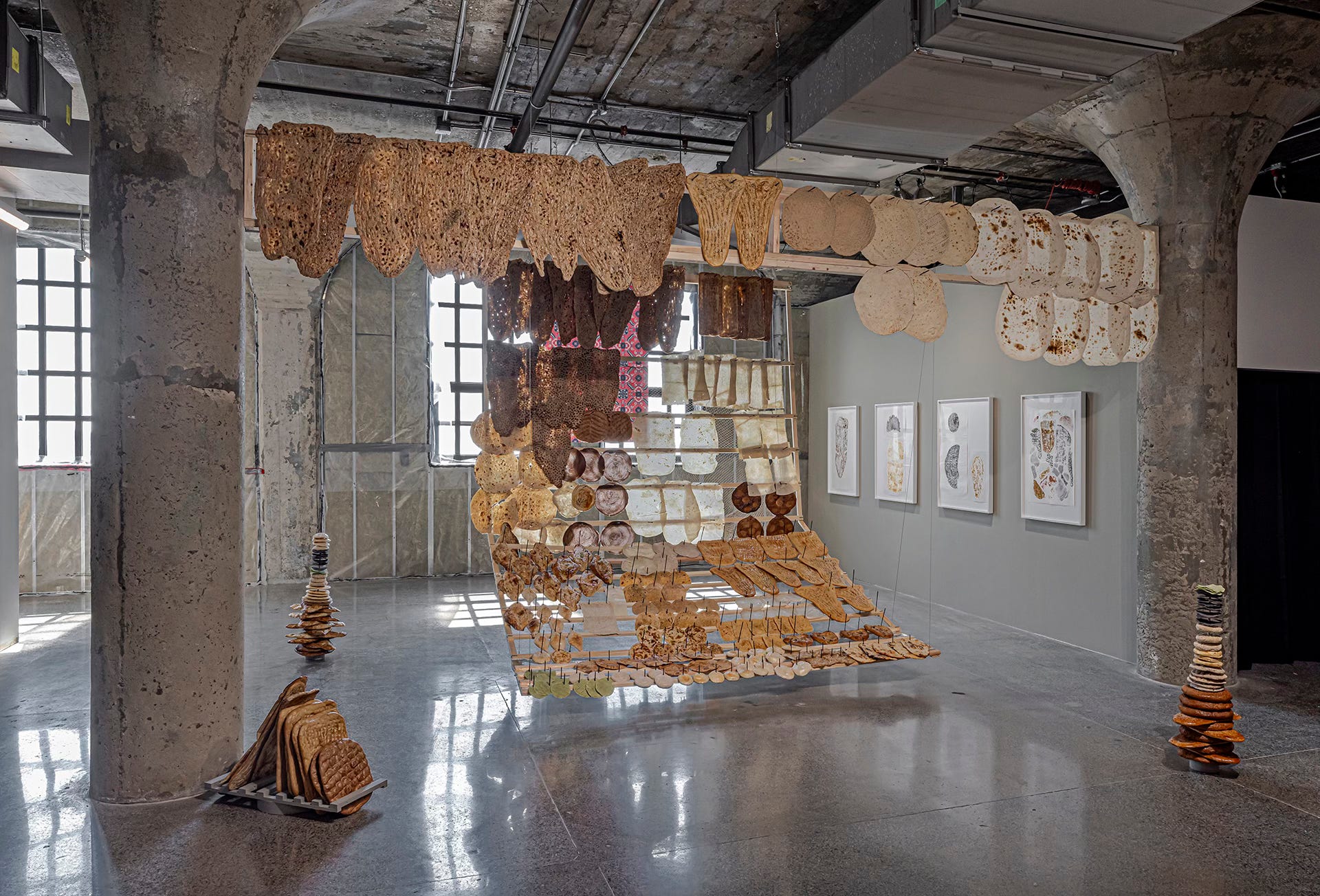
S.F.: Part of the fascinating thing about having a deeply contemplative practice is that there are so many “coincidences” that pop up. If you take the time to listen to the flows of images or ideas that are passing through your body, it’s incredible how connected we actually are to our own families, our own heritages. I did a huge project in the last couple of years about bread, the flatbread libraries: I looked at their ephemeral quality and asked why they don’t appear in museums even though they’re in charge of our survival as a human population. The most important culture is rarely in a museum. But also the surface, the marks on the bread… The fingers, the scrapes on these large Afghan breads or the pebbles on the Iranian bread, they speak about gesture and landscape and embodied knowledge. So I embarked on this project, and when I was halfway through it, my father said, “Sameer, you know that our family traded kitchen implements along the Silk Road? That’s what your ancestors did”. I’m making sculptures of rolling pins, plates and baking stuff before he told me that. I’m recreating all of this kitchen material, talking about working class history. I’m intellectualizing it within our current context, but my great uncle and my great grandfather were trading kitchen stuff. It was fascinating.
J.P.R.N.: Speaking of intellectualizing and instinct, you love going to places and being inspired by context. Now that we’re talking about serendipity in relation to heritage, how much do you prepare for these encounters?
S.F.: Being here, hosted by Worlding, is a perfect example of that. Before coming, I did some preparations about where I want to put my body. But then, I can’t really control those situations, who I’m going to meet or the conversations I’m going to have. And that highly affects the directions I go in. So, as an artist, I just have to set myself up for perceptive sharpness. It’s almost like training. Sometimes I think that the only really important thing is a good pair of shoes, sleep and making sure I eat properly so that when I’m in these spaces, I’m at my best to receive what comes.
J.P.R.N.: Do you have another example of an experience leading to a project?
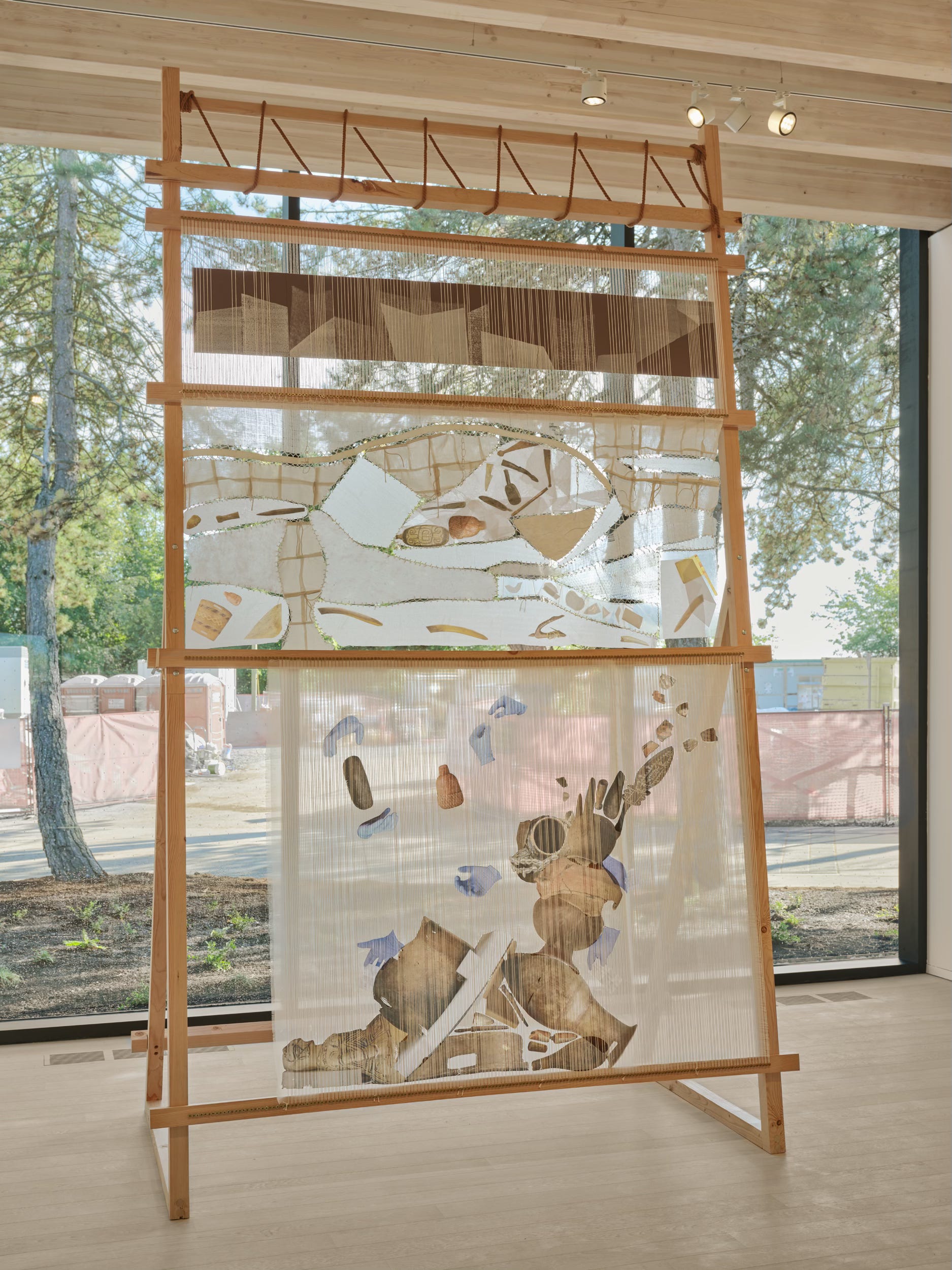
S.F.: My show called The Fairest Order in the World, which is touring now in five institutions across Canada, was built from an archive of observations of museum display cases. I photographed museum displays from Anthropology Museums in Mexico, Tetuan, Morocco, Istanbul, Canada... I have an almost Aby Warburg-esque taxonomy of them. This comes from that deeply observational methodology. I would photograph works, print them out in combinations of folders and spend a lot of time with the images. That’s when I came up with the idea of imagining objects exiting the display cases and built a photographic method for what I call “the language of exit”. What would it look like if objects had free will and could leave the museum?
The Way of the Artist
J.P.R.N.: You worked with the American poet Jared Stanley several times. You have an ongoing collaboration with the Dutch artist Mirjam Linschooten. How important are collaborations for you and how do you handle them as an artist in terms of authorship?
S.F.: At the seat of my practice is critiquing expertise, I think that level of ego creates a lot of blind spots, especially when you’re dealing with history, for example. To collaborate is very important, to share authorship. The poet Jared Stanley is a wonderful person to think alongside of. I’m talking – he’s taking notes; he’s talking – I’m taking notes… We create clouds of ideas through talking, experimenting. Working alongside someone gives you a little bit of bravery; going in alone to these large institutions can be daunting, sometimes. These are also cross-cultural collaborations: Jared and Miriam, and myself, we’re from very distinct cultural contexts. And, as you know, the art world operates in bubbles, and we need to have mobility between them. I love how you brought in Marxist framework, I think it’s an important idea within our conversation, which does not come up as much as it should in the arts scene in Canada. Conversations like these, I think, are vital. It helps provide different framing for the work. But when I do work alone, which is quite a lot, I think it’s less about owning the work; it’s more about peace to go about and do something on my own. Collaborations involve personality or practical management – and you have to raise extra funds. Sometimes you want to do something on your own, quickly.
J.P.R.N.: What artists have had an influence on you? Artists that shifted or awakened you somehow?
S.F.: I wanted to become an artist after seeing the dance work of Belgian dancer/choreographer Anne Teresa de Keersmaeker; the Mexican artist Gabriel Orozco and his relationship to the body and sculpture.; I’m fascinated by artists who order the world in a woven (not taxonomic way) such as the Portugese artist Leonor Antunes or the Ghanaian sculptor El Anatsui; there are also brilliant artists in my community that have deeply affected my practice such as Canadian artists Serena Lee, Sukaina Kubba, Swapnaa Tamhane, Shahana Rajani, among many others.
J.P.R.N.: Do you see culture in a Hegelian way, where art replaces religion and then something replaces art?
S.F.: Loaded question! The only thing that’s coming up is that sometimes, in moments of great desperation, when our art institutions are failing us, when there’s no money, when I wake up anxious in the morning and think “what sort of mistake did I make, deciding to become an artist? How am I going to survive? What’s going to happen when I get arthritis and gout and break a leg?!”, I think that besides being an artist, the only other thing is being a nun. Not even a monk, because I would rather hang out with women than men. The answer to your question is just a single word: freedom. But the context is changing, artists are losing grip on the art world, as if we were not part of it anymore. You can’t get a Venice Bienniale accreditation as an artist, only as a curator, a journalist… So I say, jokingly, that I’ll become a nun… but for the freedom. As for the question about art evolving toward a replacement, to some higher spiritual calling? I think there is only a perpetual goal: to be free, in the world. That was the promise. The artist plays with what the world has to offer. But it does seem to be impinged upon lately.
News 📣
Worlding is partnering with Collective Aid, an organisation whose mission is to prevent border violence. Our purposes overlap in promoting togetherness and growth, each in our own territory, but also together, and… with you. Your support can change the amplitude of their actions.
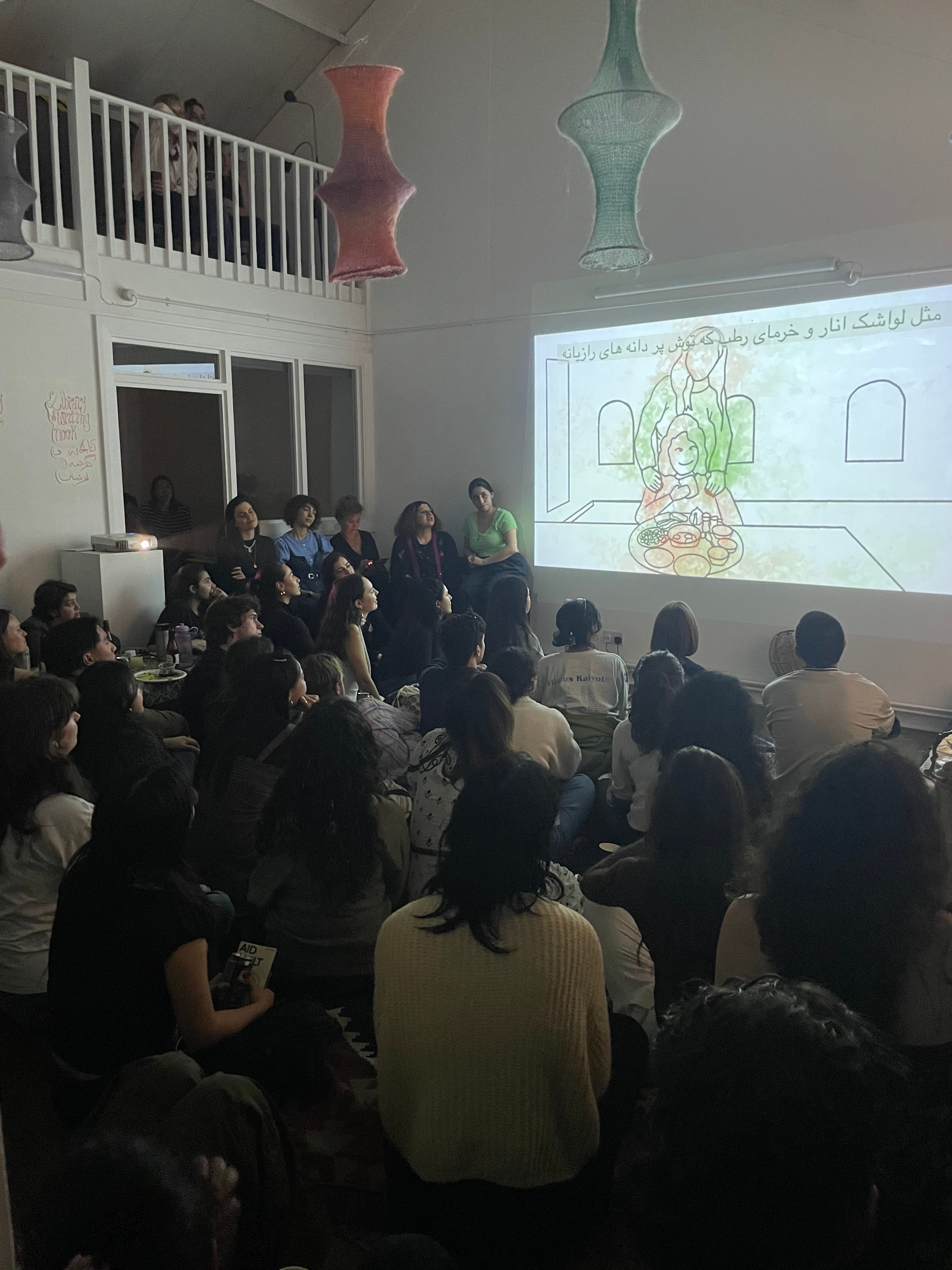
Our first collaborative event, Bani Ādam, celebrated Iranian food, cinema and drawing.

Ann Laura Stoller, Along the Archival Grain, Epistemic Anxieties and Colonial Common Sense, 2009, Princeton University Press.


Very enjoyable conversation! I appreciate the thoughtful nature of Sameer’s work and general perspective. The “flatbread library” was particularly interesting; those “coincidences” are fascinating indeed! 🙏
Really interesting interview! I'm going to have to get a copy of Ann Laura Stoller's book.. (small world that he was in McGill's Anthropology department!).